Blogs
January 12, 2026
Jurre Homan
Oddity.ai
In care organizations, stress rarely comes from a single moment. It comes from uncertainty. From not knowing what is unfolding on the floor right now. From realizing, often after the fact, that earlier awareness or a different leadership decision could have changed how a situation unfolded for staff and recipients of services.
This uncertainty is not an individual staff failure. It is a leadership constraint. When insight arrives late, leadership options narrow, and pressure shifts downward onto people already managing complex situations. Earlier insight expands the range of leadership choices available, allowing decisions to be made before situations escalate and before stress accumulates on the floor.
This is why real-time safety in care matters at the leadership level. Not only because technology itself creates safety, but also because timely insight enables better leadership decisions. And those decisions are what people on the floor actually experience as calm, safety, and stability.
Most challenging situations in care do not unfold in a single moment. They develop over time, often through a sequence of small, early signals that are easy to miss when teams are stretched.
A shift in tone. A moment of restlessness. A situation that begins to require more attention while staff are already managing competing demands. Time passes. Sometimes seconds matter, but without real-time visibility, leaders often only become aware once escalation is already underway.
When awareness arrives late, the effects compound. Delayed insight directly limits leadership choice. Fewer options remain, and decisions become focused on recovery rather than prevention.
For staff, this means greater uncertainty and pressure. They may hesitate to ask for help, unsure whether leadership support will arrive in time or whether the situation meets escalation thresholds. Over time, this affects care staff safety, confidence, and retention.
For leadership teams, delayed insight increases downstream consequences. More recovery work. More documentation. More staffing adjustments after the fact. More effort was spent rebuilding trust with teams who felt unsupported in the moment.
This is the hidden cost within incident prevention in human services. Not the situation itself, but the organizational load created when leadership decisions are forced to happen too late.
Traditional reporting tells leaders what already happened. Real-time insight shows what is developing right now.
This changes the leadership role of safety data. Instead of reviewing isolated reports days later, leaders gain early signals and emerging patterns. They can see where situations are becoming strained, where staff may need reinforcement, and where conditions are likely to escalate without timely support.
This is where AI safety monitoring healthcare supports leadership decision-making. Not by directing action, but by ensuring insight reaches leaders quickly enough to matter.
Earlier visibility enables concrete leadership actions, such as adjusting staffing in real time, redefining escalation thresholds based on current conditions, or deploying experienced support to specific areas before stress spreads. These are leadership choices, made deliberately, because insight arrived early enough to allow them.
This is the core of leadership decision-making in care. Technology reduces uncertainty, but leadership determines the response.
Calm is not accidental. It is the result of consistent leadership decisions made with enough time and context.
When leaders see earlier, they can decide earlier. Support arrives before situations intensify. Reinforcements are predictable rather than urgent. Escalation decisions are consistent across shifts, not dependent on who happens to be present.
Over time, this produces clear human outcomes:
These outcomes are not driven by technology alone. They are the direct result of leadership choices made with better information. This directly affects staff wellbeing human services leaders are accountable for, through operational clarity rather than messaging.
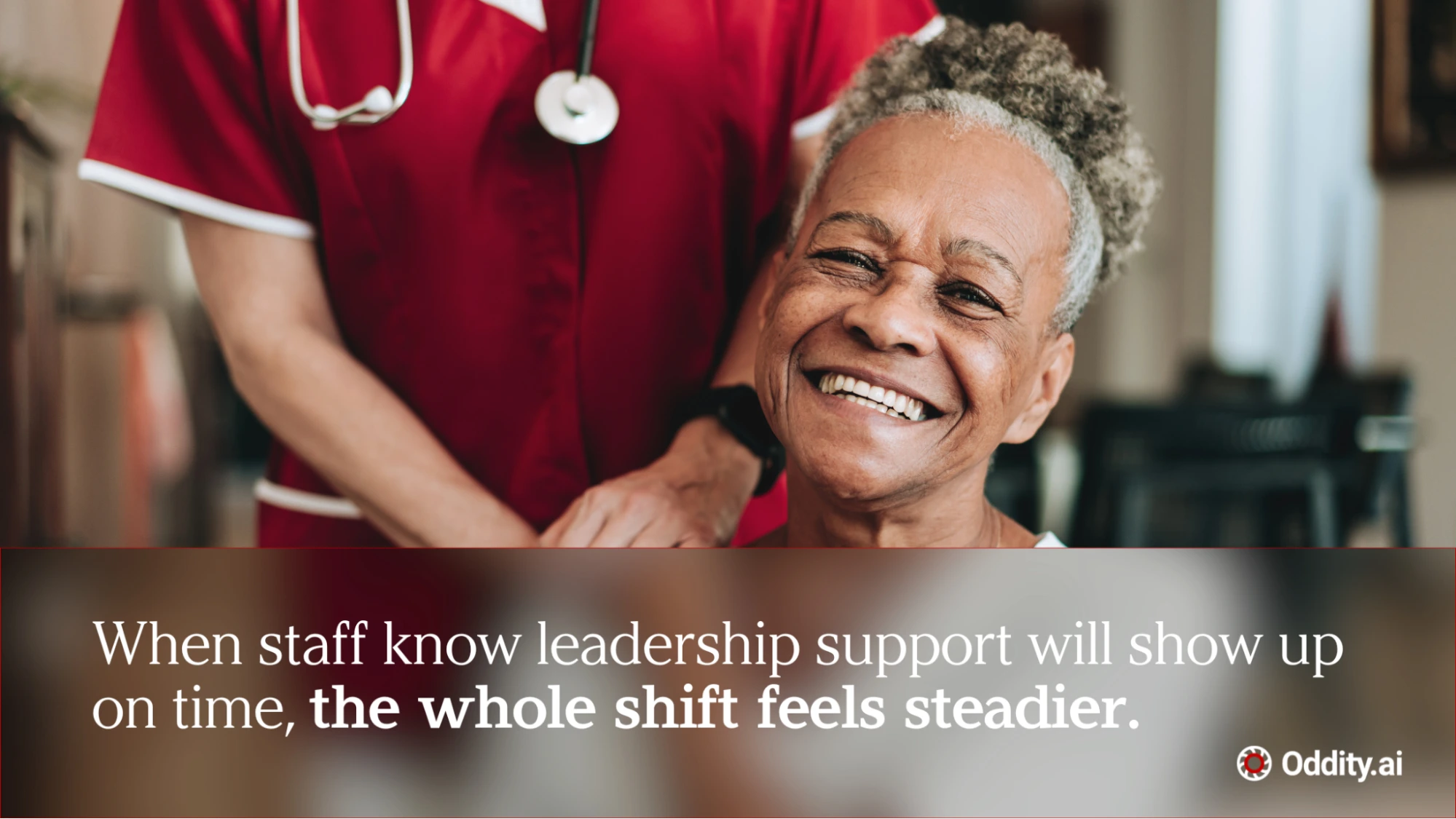
Recipients of services benefit in parallel. Earlier leadership intervention supports calmer responses, preserves routines, and protects dignity. The environment remains steady because leadership decisions are made before disruption spreads.
Safety systems are often treated as tools. Something implemented, reviewed, and discussed mainly after something has gone wrong. Real-time safety insight functions differently. It is leadership infrastructure.
Like financial or operational dashboards, safety insight supports executive governance. It gives leaders predictability, control, and confidence in how the organization responds under pressure. It allows leadership to steer conditions, not simply react to outcomes.
This is where care compliance and safety intersect with governance. Secure cloud architecture, full encryption, and HIPAA-compliant design are not checklists. They enable leaders to rely on safety insight as part of organizational control, knowing trust and privacy are protected.
When safety insight is embedded into leadership routines alongside other decision-support systems, it strengthens organizational stability and reduces downstream disruption.
No. When designed well, real-time safety systems reduce cognitive load. Staff are not asked to monitor dashboards or add documentation. The intent is to enable leadership decisions that reduce pressure on staff before situations escalate.
Privacy and compliance are foundational. Secure cloud-based architecture, full encryption, and HIPAA compliance ensure safety insight is handled responsibly. Clear governance allows leadership to use insight confidently and consistently.
Impact appears as fewer downstream consequences, steadier staffing pressure, more consistent responses across shifts, and increased confidence among teams. Prevention is reflected in stability and predictability, not just reduced reports.
Safety technology is not the outcome. Leadership decisions are.
Calm, stability, and dignity in care environments emerge when leaders make consistent, timely decisions supported by early insight. When leaders see earlier, they decide more deliberately. And when decisions improve, people feel it through steadier shifts, reduced pressure, and greater trust.
If you are rethinking how safety decisions are made in your organization, this is where the conversation starts with our team at Oddity.ai.
Explore how care organizations are using Oddity.ai's real-time detection to enable better leadership decisions, create calmer environments, and protect staff and recipients of services — safely, privately, and sustainably.
Learn more about Oddity.ai: plan a demo